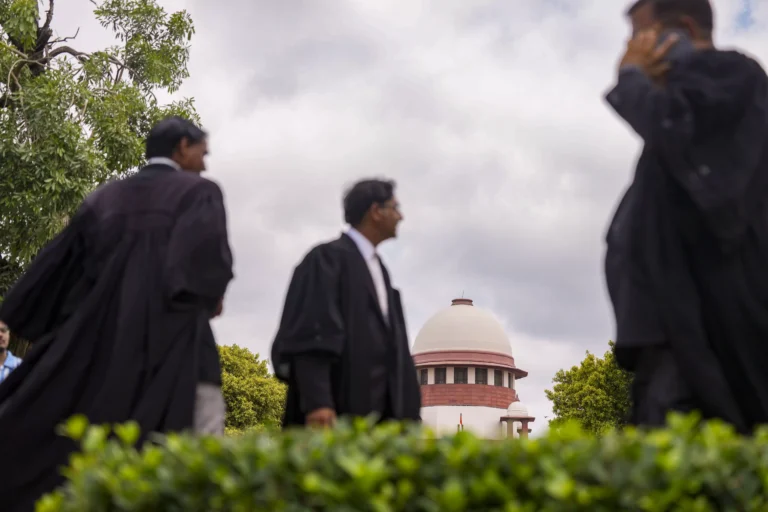

New Delhi, May 14, 2025 – Justice Bhushan Ramkrishna Gavai was sworn in today as the 52nd Chief Justice of India (CJI) in a ceremony held at Rashtrapati Bhavan. The oath was administered by President Droupadi Murmu, marking a historic moment in India’s judicial history. Justice Gavai succeeds Justice Sanjiv Khanna, who retired on Tuesday after a tenure of six months.
A Historic Appointment
Justice Gavai’s elevation to the highest judicial office is both historic and symbolic. He is the first Buddhist and only the second Dalit to hold the position of CJI, following Justice K.G. Balakrishnan, who served in 2007. His appointment is widely seen as a milestone for diversity and inclusion in India’s judiciary.
Born on November 24, 1960, in Amravati, Maharashtra, Justice Gavai comes from a family deeply influenced by Dr. B.R. Ambedkar’s ideals and the Buddhist faith. His father, R.S. Gavai, was a prominent Dalit leader, parliamentarian, and former Governor, instilling in him a strong sense of public service and social justice.
Journey to the Supreme Court
Justice Gavai pursued law at Dr. Babasaheb Ambedkar College of Law, Nagpur, and enrolled as an advocate in 1985. Over the years, he built a reputation as a sharp legal mind, specializing in constitutional, civil, and administrative law. He served as standing counsel for municipal bodies and educational institutions before being appointed as an Additional Judge of the Bombay High Court in 2003. He became a permanent judge in 2005 and was later elevated to the Supreme Court in 2019.
During his tenure at the Supreme Court, Justice Gavai has contributed to several landmark rulings. He was part of the five-judge Constitution Bench that upheld the abrogation of Article 370, reshaping the constitutional status of Jammu and Kashmir. He also played a key role in striking down the electoral bonds scheme, a move hailed by transparency advocates.
Challenges Ahead
Justice Gavai inherits a backlog of over 81,000 cases, a challenge that has plagued the judiciary for years. His tenure will focus on judicial appointments, constitutional matters, and streamlining case management. He is expected to preside over important constitution bench matters, including cases related to the Places of Worship Act and the Waqf Amendment.
A Vision for Inclusive Justice
Justice Gavai’s appointment is seen as a beacon of hope for marginalized communities. His rise from humble beginnings to the highest judicial office reflects the transformative power of education and perseverance. Addressing a function in April 2024, he credited Dr. B.R. Ambedkar for paving the way for individuals from downtrodden communities.
As he takes charge, Justice Gavai has vowed to uphold the principles of fairness, transparency, and judicial independence. His tenure will be closely watched as India navigates complex legal and political challenges in the coming months.
About the Author